
History of Chinnor Flower and Produce Show
Part One
Our first event was held in the grounds of the old Chinnor Rectory on 10 August 1910, in the area that is now the residential road called Rectory Meadow.
Shows like this had become a popular Edwardian pursuit around the country. They were encouraged by the local gentry and the clergy, who could provide both prizes and a field for the marquee and sideshows. Although some classes have changed over the years, these shows also included many non-horticultural classes much like today.
We still have the minute book from that period showing the very large committee and the meetings they had leading up to the first Show. It was the Rector of Chinnor, the Rev.L. Baldwyn, who called the first meeting and acted as Chairman. Also on the committee was the Rector of Emmington, the Congregational Church Pastor, a local JP and about 15 land-owning gentlemen and farmers as well as some tradesmen including the landlord of the Kings Head.
The allotment movement was in full swing in Chinnor so working people now had some land of their own to grow vegetables and flowers. With the increase in popularity of dahlias and chrysanthemums, and considering the harvest time for vegetables like potatoes, carrots, leeks and onions, the best time to have a show was in August or September. Our first shows were held in early August as that is when the Bank Holiday was in those days.
The attendance at the very first show was estimated to have been over a thousand people, roughly equivalent to the entire population of Chinnor at that time!
The minute book records the Show –
“The weather was fine and everyone seemed to enjoy the pleasant afternoon and evening. The day seemed to mark a new departure in the history of Chinnor. Bowling for the pig was very popular and the display of the Boy Scouts under Scoutmaster Cecil Fleming Baldwyn as also the Sports were much appreciated. The evening concluded with dancing to the strains of the Thame Band”
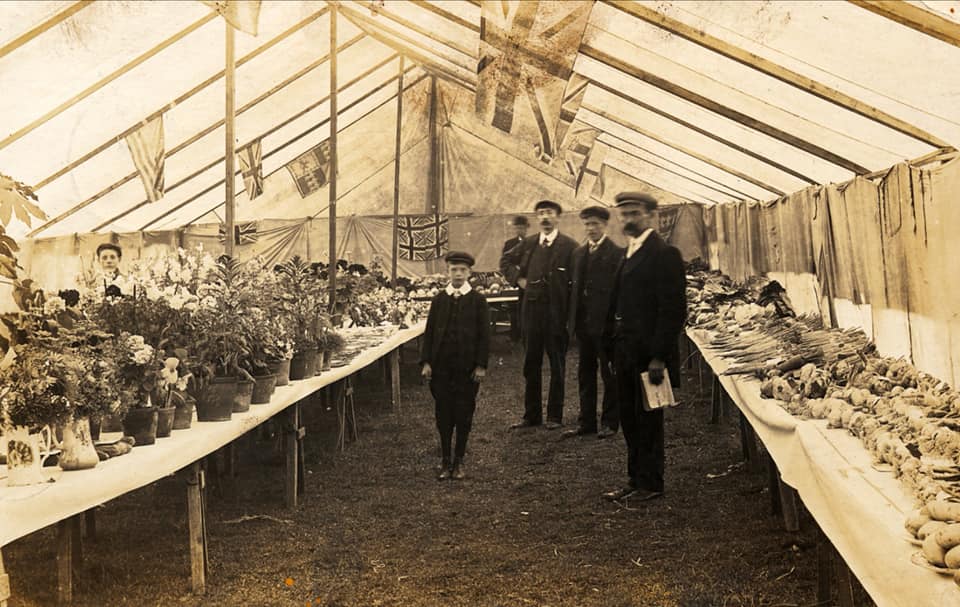
Early flower show, location unknown (Flickr image used with permission)
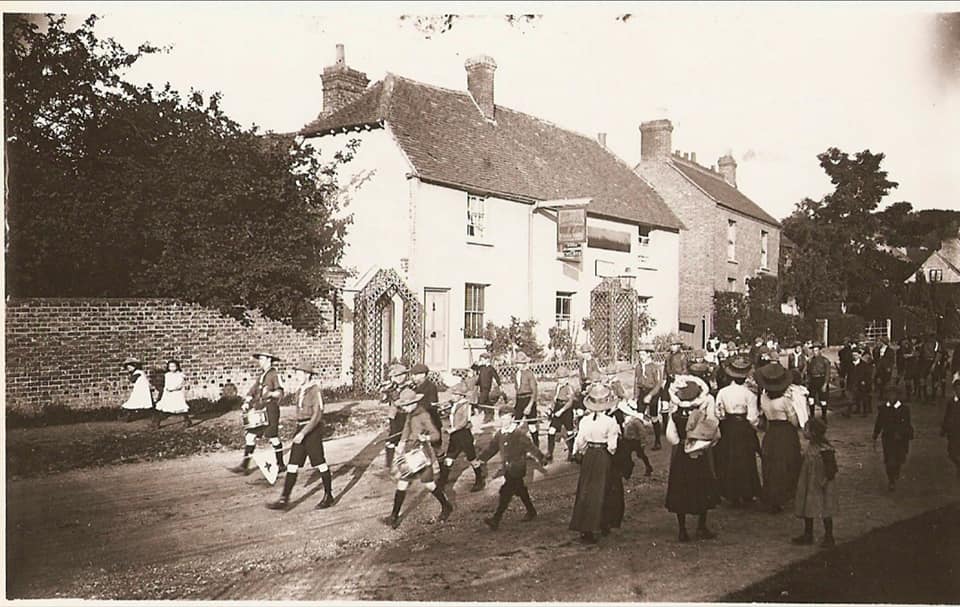
Boy Scouts marching in Chinnor High Street around 1910 (copied with permission from collection of Chinnor Historical Society)
Part Two – Early Shows
After the great success of the first ‘Chinnor, Crowell and Emmington Flower Show’ as it was called, the event has continued more or less uninterrupted (apart from the War years) into the present day.
The very early Shows were financed by collections of a ‘subscription’ around the various parishes, including Oakley and Henton. There were designated collectors for each area and they were allowed to keep a commission for themselves.
These shows must have been very lively affairs with various sporting events and games taking place on the field in the afternoon. Then there were side-shows and maypole dancing to watch, as well as the exhibition of vegetables, flowers and other produce in the marquee. What was ‘Kicking the Chivvy’ and the ‘Aeroplane Trip’ where the winners received prizes of cigarettes and chocolates?
In the evening there was always dancing to a live band.
Thame Band attended the first two or three Shows, but later the Committee asked Chinnor Band instead and they received £2 plus their afternoon tea.
By 1914 there was even more to do, with the addition of Ladies bowling – first prize a tea service – and a football kicking competition.
But after this Show there was a long break because no more shows were held until the Great War had finished.
In 1919 life began to return to normal and the Show returned. Classes for children were introduced for the first time, with ‘Brush work’ for Boys and ‘Needlework’ for Girls.
Were the children’s classes added to make up numbers as after the loss of so many men, perhaps show entries would have been down? Whatever the reason, a Show without children’s classes would be unthinkable today.
And finally the long-suffering Mrs Witney was paid for the tea she had supplied to the Band five years earlier in 1914!
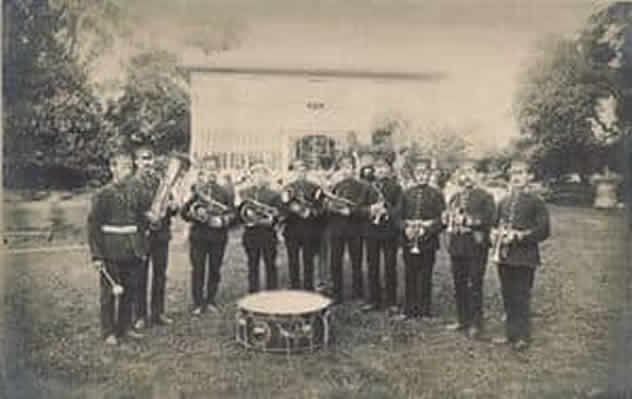
Chinnor Silver Band on the Rectory Meadow, taken around 1895 (copied with permission from Chinnor Silver Band)

Edwardian ladies bowling (image from FreePix)
Part Three – The 1920s
In 1920 the Flower Show Committee got together with the War Memorial Committee and together put on an bumper August Bank Holiday Show with the intention of making money.
This show had the usual exhibits and side-shows with some new ideas such as a cocoa-nut shy and a Concert. There was also a Carnival Parade with five categories to enter. The first prize for Adult fancy dress (both Lady and Gent) was £1, which must have been well worth winning in 1920.
All the profits that year went to the War Memorial Fund – as there were no government grants and each Parish was expected to raise funds for their own Memorial if they wanted one. This is still the site of our Chinnor parade and ceremony every Remembrance Sunday in November.
Feelings must have run high in 1923 when there was a last minute panic in August. An emergency meeting was called to discuss an objection to the size of one of the Crowell allotments, said to exceed the 20 poles specified in the schedule for ‘ best kept allotment’. In the event the entry was allowed after careful measurement showed that four of the allotments exceeded 21 poles! By the way, I believe most of today’s plots in Chinnor are just 9.5 poles. Exhibitors were asked to leave fruit and vegetables behind not for auction as we do now, but to send food to the local hospitals.
Six years later the Flower Show was able to donate money to the Extension Fund of the Radcliffe Infirmary in Oxford, following an auction of exhibits. This was the hospital that Chinnor people went to if they needed more treatment than the cottage hospital at Thame could provide.

Chinnor War Memorial (author’s own photos)
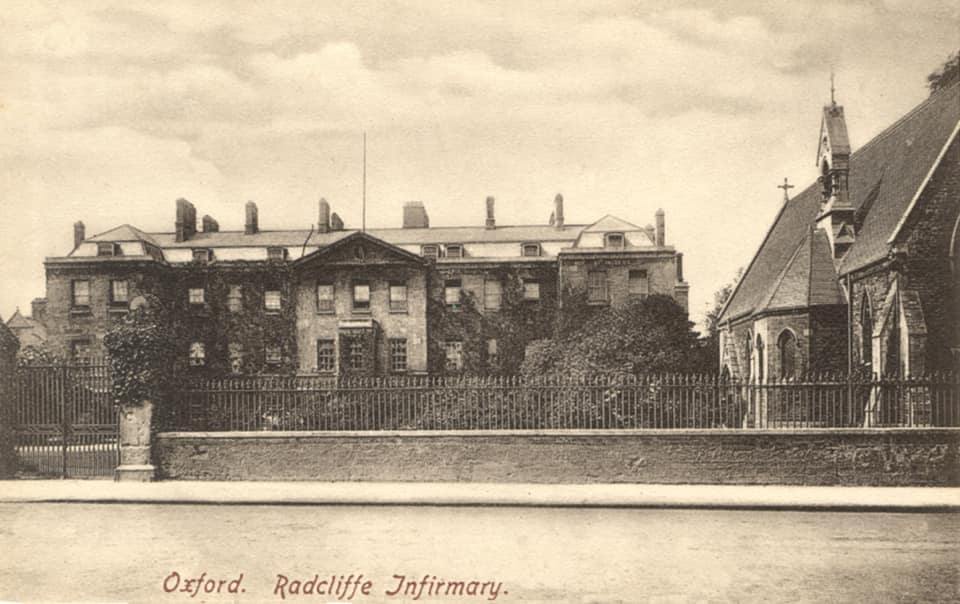
Old postcard showing the Radcliffe Infirmary, before WW1 (courtesy of www.oxfordhistory.org.uk)
Part Four – The 1930s
Early in 1930 the committee asked five bands to tender for playing at the Show – Chinnor, Stokenchurch, Monks Risborough, Naphill and Flackwell Heath. Surprisingly this was nothing new, for in 1922 they had asked Haddenham, Ickford and Chalgrove bandmasters. It seems that there were many competing attractions on August Bank Holiday Mondays and Bands were in great demand, but I wonder how many of those listed above still exist today, apart from ours?
There was also discussion about ‘intoxicants’ being allowed on the site but this idea was firmly turned down and an outside caterer sought to provide teas. I noticed from the minutes that after the first show there were always police in attendance, paid for by the Flower Show! Ironically it was Mr Pearson of the Swan Hotel, Thame who got the job of providing teetotal refreshments and ices in 1930.
In 1931 Aston parish was included in the show, and Sydenham had already joined in 1928, so there was an even larger committee with reps for all the parishes. They had a big Show on their hands, and various allotments sites (including the School allotments), to be judged in advance sometime in July.
600 Schedules were ordered – and a bigger flower tent to accomodate the new category of ‘table decorations’ – what we now call Flower Arrangements except that then the exhibitor had to grow their own flowers. The Sports were again held on Rectory Meadow and later the prize-giving took place at 6.30 pm, no doubt followed by dancing late into the evening.
The original minute book runs from 1910 to 1934, and ends on a low note. At the 1934 AGM there was little interest in putting on a Show following increasing financial losses incurred over the last few years, so the Committee decided to let the show lapse and look again the following year. The Rector Leonard Baldwyn who had started the Show and always been the Chairman, sadly passed away in late 1934 and there is a stained glass window to his memory in St Andrews Church, Chinnor.

Chinnor Silver Band in the 1930s (copied with permission from Chinnor Silver Band)
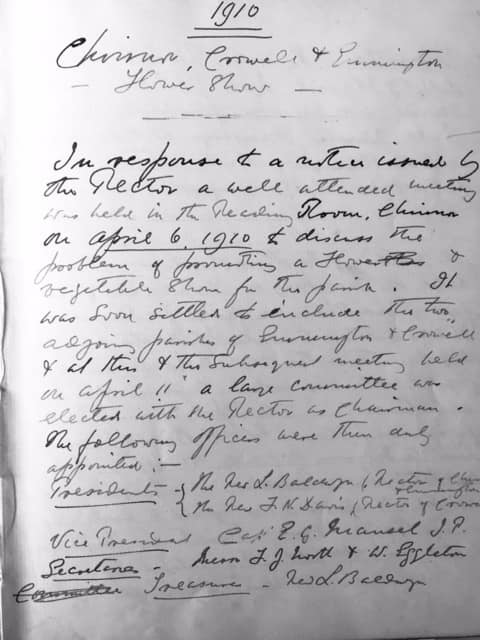
Original minute book first page (property of Chinnor Flower Show)
Part Five – The 1940s
At last we have a surviving Schedule – the first we know of. After the War a ‘Victory Garden Show’ was held on August 6, 1945 and there were some surprising classes to enter. But more of those later……….. All proceeds that year went to St Dunstan’s, a national charity set up to support blind veterans in WW1 and still going today.
Apparently there had been a small Garden Show and Concert held at short notice in 1944 (during the War) and it had raised £140 for the Red Cross. This 1945 show was on August Bank Holiday Monday and held as usual on the Rectory Meadow, with a concert on the Friday evening before.
There were 117 classes to enter and an auction of gifts by a London auctioneer. The Committee was about 20 strong with additional named organisers for each of the sections.
Miss E Leverkus was in charge of the ‘Kitchen Front’ and her sister Dr. D Leverkus in charge of ‘Babies’. Yes, there were 10 classes for showing babies – the longest lashes, boy with the most curls, best clothes made by mother and so on – but the real shocker today is ‘Baby with the best sunburn, any age up to two years’!
And then there were the rabbit classes (grouped in with poultry and eggs) which amazingly numbered 31 separate classes. A reminder of how important rabbits were both for meat and fur during the War, and what a popular hobby breeding the different varieties must have been – Chinchilla, Havana, Rex and so on.
Again Fancy Dress featured, this time including decorated bicycles and prams, with a lady judge coming from Nettlebed. The vegetable judge was a farmer from Watford, perhaps it wasn’t advisable for anyone too local to be a judge.
And finally the Children’s section, only four classes to enter but nothing like today – thank goodness! Three classes of picked wild flowers, including a bunch with the largest number of different types, and then the ‘Largest collection of White Cabbage Butterflies’. How the butterflies were presented I don’t know, maybe in a jam jar? But how times have changed . Then they were a pest, now we are pleased to see them. Not to mention not picking wild flowers.
Collections of pressed wild flowers were included as a class right into the 1960s. I wonder what classes we have in this year’s Show which might surprise future generations?
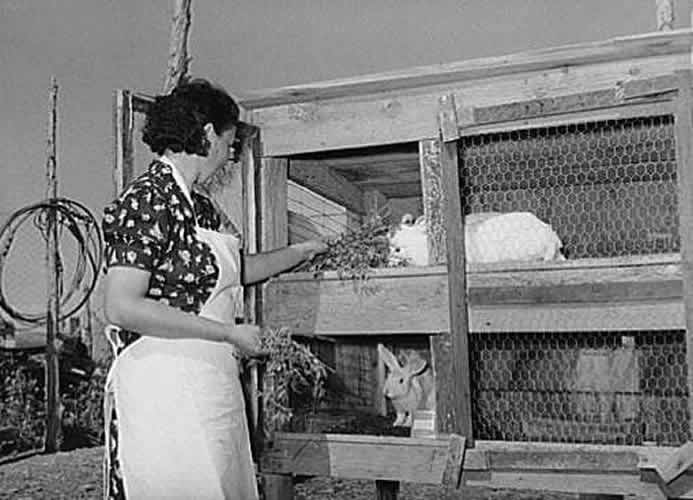
1940s rabbit farming (From Wikimedia Commons, the free media repository)

Kitchen Front and Honey sections from the 1945 show (property of Chinnor Flower Show)
Part Six – 1950s/1960s
The Show was now being held on the second Saturday in September, about a week before Thame Show.
During the 1960s the event had to move to the Village Hall because the old Georgian Rectory was pulled down in 1962 and most of the grounds built on. Now there was bingo in the evening, no sports other than bowling and perhaps not so many sideshows.
We do have a minute book running from 1958 – 1988. Signs of continuing post-War austerity in the early entries include the 20 dozen bridge rolls filled with cucumber, tomato and a tin of meat – let’s hope it was a big tin! Bowling and draw winners might receive prizes such as a ham, a fireside chair, half a tea service, half a bottle of whisky, a tin of Players Senior Service, nylons, pyrex, cockerels or a seed cake. In 1959 they sent two guineas to the ‘Kingston Blount Old Folks Party Fund’ and later Aston Rowant Good Companions and Chinnor old folks benefitted as well. Who remembers the 1960 ‘World Refugee Year ‘ fund which also received a donation?
In 1960 the home-made wine class was started, taking the place of the egg class which was no longer well supported . The wine was to be in a 1 pint bottle – not everyone bought shop wine in those days. It was also in 1960 that our longest serving President, Lord Carrington began supporting us as a Vice-President, and he continued until he passed away in 2018. He opened our Centenary Show in 2010.
In the late 60s the Committee saved a bit on printing costs by changing the name from ‘Chinnor and District, Crowell, Sydenham, Aston Rowant and Bledlow Flower Show’ to just Chinnor and District Flower Show.
We have a Schedule from Sept 14th 1968. There were five trophies to win and entrants had to come from within a five-mile radius of Chinnor.
A Baby Show was still included, with four classes now just according to age, and the Children’s section had grown to include a garden on a plate, handicrafts, painting and sketching as well as the wild flower bunches.
The Village Hall continued to be the Flower Show venue until 2000. We brought back the egg class in 2009 as back-yard hen-keeping is popular again, but so far there are no plans to bring back a ‘Best Baby’ competition……

Photo of Lord Carrington opening 2010 show (Peggy Miles)
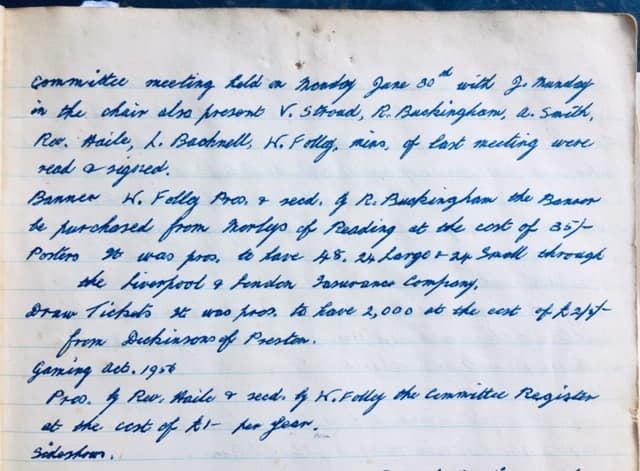
Minutes of a 1958 meeting – showing committee members and purchase of banner, posters, draw tickets and gaming licence (property of the Flower Show)
History of Chinnor Flower and Produce Show compiled by Christine Davis